Monday, October 17, 2011

Switchback Railroad Hikes - 2010 and Onward


A beautiful fall day in 2014 - our 5th, bi-annual hike.  We will repeat this
in March 2015.


The Fall 2014 is now in the books.  We were a bit behind the foliage turn this year, but the day was perfect.
 (As opposed to two years ago when we had to cancel due to snow!)

Jordan Cook and Mrs. Focht were on the 2010 Fall hike.


For more of a historical account of the Switchback Railroad, including rare photgraphs, please click this link to take you to "Students Descend Upon the Switchback Railroad" post on this blog.


Once again, students, family and staff of the Lehighton Area Middle School took part in a 3-hour hike of the remains of the Switchback Railroad engine house atop Mt. Pisgah in Jim Thorpe (formerly Mauch Chunk.) 

~August 1925 Switchback Railroad Mt Pisgah Incline Footage - YouTube

The adventurers marveled at the view and the rich history of this forgotten place, which is perhaps the most important link in the early development of coal production that fueled our Industrial Revolution.
The 50-plus hikers even ventured out to the former Hacklebernie Tunnel that was first driven in 1824 by Josiah White himself in an attempt to bring a source of coal closer to the shipping terminus at Mauch Chunk and the Lehigh River.
Here is one of the few pictures (albeit a drawing based on photos) that illustrates the entire 18-mile expanse of the
Mauch Chunk Railroad, otherwise known as the "Switchback."  You can see the dam on the Lehigh River, constructed
to create a "harbor" for canal boats to load up with coal.  To the right of the river, just above the dam, you can see the
beginning of the Lehigh Canal as it circles the bottom of "Mauch Chunk" Mountain, so named by natives as "Land
of the Sleeping Bear."  Though the "chutes" are not depicted here, you can see the red roofs of the Switchback
Station at the rightmost terminal arc.  The great plane above that is the Mt Pisgah Plane and engine house.  The
other plane is the Mt Jefferson plane and engine house that leads to Summit Hill. The straightaway from the base of
Mt Jefferson all the way to Mauch Chunk was originally a one-way "Stone Turnpike" in which the cars descended by
day and pulled back up empty by mules at night.  The planes, engines, and "backtrack" were constructed for operation in 1846.   The original "Stone Turnpike" was constructed over the winter of 1818-1819.  The entire system runs at a steady four to six percent declination or four to six feet per running 100 feet.  The one and only and entire model of the Switchback can be viewed at the Mauch Chunk Museum and Cultural Center, West Broadway, Jim Thorpe. 
The mine was not extremely profitable and was used intermitantly over the years.  Eventually it was driven clear through to the Nesquehoning side of the mountain.  Keith Bellhorn's grandfather, a miner who lived in Hacklebernie around the 1930s walked through the tunnel each day coming and going from his job as a miner in Nesquehoning.
Students gape at the view of the Lehigh Gorge - With all our recent rain, the
Glen Onoko Falls were quite visible, a rare treat for this time of year.
The Lehigh River is about 800 feet below.

The March 2015 hike was coldest one yet!  Here Emily Snyder, Hailey
Anthony, Taylor Mickley and Ricky Houser.

Grandparents, Aunts and Uncles and many students have enjoyed these hikes
over the years.  This one from Spring of 2011.

Here, Miss Finkboner makes her way across the top of the collapsed tunnel.
Since the tunnel was driven in 1824, 24 years before the construction of the
Switchback's "backtrack," a short trestle was built to traverse the mine.
This is also the place where the Switchback actually got its name from the Y-
switches that allowed descending coal cars to zig-zag down the mountain
side, each time it reached a terminus or switch that kicked the car onto the opposing
section, "switchbacking" down the mountain, eventually connecting to the "downtrack"
and on down to the coal chutes to the Lehigh River.

Parents and students were eager to see the mine's entrance, defying the steep
30 foot drop.


TOP: Ryan Graver and his father on the flat in front of the mine March 2015.  Students (above) hike across the top of the tunnel in the Fall 2014 hike.  Though many find themselves scaling this narrow ledge, one need not cross it to continue on this hike.  Madison Brown and her father enjoyed the challenge.  Students from 2010 (below) were enthusiastic to find the entrance of the collapse tunnel, the first coal
mine tunnel ever driven in North America (1824).

Emily Snyder and Gabi Steigerwalt in October 2014.
Students even scaled the side of the mountain to reach the nearly closed opening of the collapsed mine tunnel.
Fall 2014 - Looking out from inside the Hacklebernie Tunnel - first driven
in 1824.
Among the students attending the hike, along with parents, grandparents and siblings were: Shain Hrusovsky, Emily Miller, Haley Nahf, Sam Maholick, Jordan Cook, Gavin Sherer, Grace Lienhard, Emma McClafferty, Lily Hutton, Scott Kuzma, Cameron Zerbe, Lindsay Carrigan, Kelsey Knappenberger, Daniel Brown, Ryan Nametko, Trent Derhammer, Daniel Thomas, Isabelle Meckes, Justice Schlier, Amanda Mathisen, Gage Whiteman, Seth Nace, Mark Solt, Brooke Focht, Benjamin Mathisen, Emily Bartron, and Alex Hawk.
Everyone had a blast.

Students even were able to make 3 different GeoCache finds at the Fall 2010
hike included from left: Amanda Mathisen, Haley Nahf, Ben Mathisen, and
Isabelle "Belle" Meckes when they were in 5th grade.
Among the L.A.M.S. staff members attending the hike were Mark Maholick, Jake Molchany, Carly Finkboner, Mollie Llewellyn, Sharon Focht, and Ronald Rabenold.

A repeat of this hike is planned for April.  Part 2 of the hike, the "downtrack" and downtown Jim Thorpe tour ending at the Mauch Chunk Museum and Cultural Center with its complete Switchback Railroad train display, is planned for early May for 3 evening tours.  (See The 'Essential Jim Thorpe Tour' is our Spring hike, Part II of the Switchback tour.)

Related links on this website:
Spring Hike 2011(This post has many vintage photos of the SBRR), Josiah White's Genius, October 2010 Hike, PA Canal Society Visits Mt Pisgah, and My Sunday Hike.
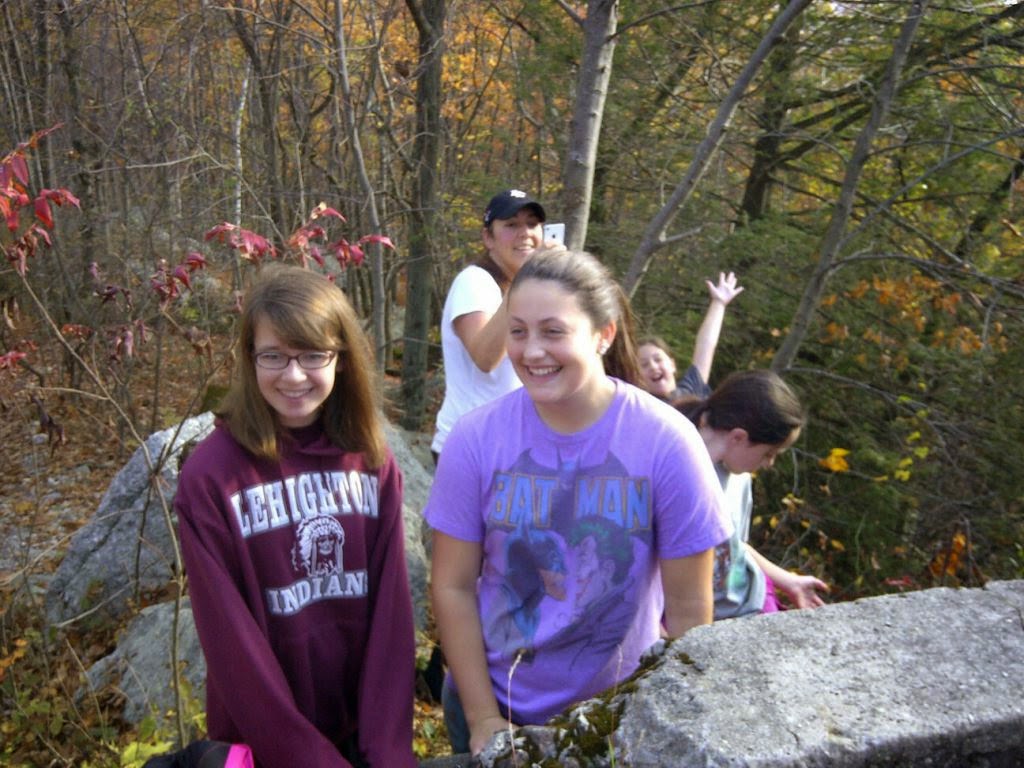
Haley Nahf and Belle Meckes return as 8th graders for the 2014 hike as
 Belle's 5th grade sister Abigail photo-bombs.
(Hailey even wore the same Lehighton hoody she wore when she attended
her first hike above. 
Also, if you are looking for a comparable site in the area, I suggest you look into the Penn Haven Junction inclines of the Beaver Meadow Railroad above the Black Creek.  In the "Virtual Lehigh Gorge" tour, about mid-way through, are pictures and some history of those dual inclines that once operated there.


CLICK HERE - For the Spring 2011 Hike with a more complete Switchback history and rare photos. 

~~~~~~~~~~~~~~
April 2014 Hike Update -

We had another succesful, memorable and injury free hike this past Easter Saturday, April 24th, 2014.  The following are some picture highlights.  There were over fifty students, parents, brothers and sisters in attendance.  The late spring and lack of foliage offered a more unencumbered view than normal for late spring.  It allowed us to see Lock #1 of the Upper Grand and a swollen Glen Onoko Falls.  Any day in nature is a good day.  A day getting kids and their families connected with nature and each other is a great day!  Go exploring!  (One LAMS student was among our number.  Known as "The Kid in the Tent," he too writes a blog and it is well written.  He also documented the hike which can be read by clicking here.) 

The following pictures encapsulate the main points of the hike:
Some of the families from the Fall of 2014 hike gather
near the top at the foot of the trestle abutment.

The Easter Saturday 2014 hikers on top of Mt Pisgah one of the largest groups up to then.

A portion of the October 2014 group near the base of the trestle.
This group numbered near 80, the largest tour group to date.  Thirty-six 5th-grade students attended, many with both parents, some siblings and even a grandparent or two attended.

Pre-hike instructions and Switchback history overview Spring 2014.


The steep grade of the Wagon Road up the side
of Mt Pisgah always seems to catch more than a
few people unprepared.  Many were waiting and catching
their breath at the first of two hairpin turns - Spring 2014.
Perfect weather for "The Kid and the Tent" and his friends to take
in the view of the Lehigh Gorge as well as the Glen Onoko Falls - Spring 2014.
Outside the Hacklebernie Tunnel - Driven to a depth
of 790 feet from 1824 to 1827, it is said to be the oldest
coal mine tunnel in North America - Spring 2014.
"The Kid" explores inside the tunnel. - Lyle Cordes examines the rock formations
in the ceiling of the Hacklebernie Tunnel in Spring 2014.

End of the Hike - Going in reverse order - The hike
culminates with a quadricep-jarring descent down the
1/4 mile plane where cars were once pulled up.  Kurtis
Gustafson and Tate Sharrow enjoy the top of the descent
in Fall of 2014, while looking downward near the same
spot were hikers from the Spring 2014 hike.
(For more information click the link at the beginning
of this post or schedule a tour at the
Mauch Chunk Museum and Cultural Center.  

Emily Snyder and her grandfather Captain Nick Waits, a retired Air Force dentist, enjoyed the Fall
2014 hike.  Thanks for the pictures Capt Waits.  There is also a pictureof Capt Waits and his family on the Lehigh Gorge post here.
Students who attended the Fall of 2014 hike were: Jayla Knight, Kendra Mosteller, Grant Rimbey, Tate Sharrow, Dylan and Kenneth Wallace, Madalynne Cerami, Kurtis Gustafson, Leilani McClure, Sherry Nametko, Ronald Snyder, Hailey Anthony, Dante Boni, Benjamin Slaw, Jaiden Unangst, Emily Graver, Emily Snyder, Gabrielle Steigerwalt, Mason Costenbader, Antigone Gonzalez, Kylee Schmidt, Shelby Heater, Madison Kemmerer, Shelby Kuzma, Alexis Amari, Marissa McNally, Callie Hayman, Hunter Hettler, Logan Kester, Autumn Madea, Abigail Meckes, Amanda Shaffer, Emily Tonkin, Austin Williams, and Josh Steigerwalt.

Wednesday, October 12, 2011

Salt, Time, Cabbage...and other secrets of a long and happy life

The brick-wall water filter of the old cistern, now a
ground cellar, is the backdrop of Charlie's
yearly sauerkraut making. 
Charlie learned how to make sauerkraut with his Aunt May starting in the Great Depression. He knows that sauerkraut is more than some cabbage in a crock. There’s salt and time added too. All together, it is more than the sum of its parts, as a good life is more than the sum of its days.


Many different salts have been added to the life of Charlie Fritz. He learned his way around a hammer with the guidance of his father Willard who was a fine cabinet maker. And he got a taste of farm life from his mother’s sister May and her brother Clayton "Geat" Beaver, who ran the family’s small truck patch farm in East Weissport.

Charlie’s early life was also filled with the lore of the hazards and pride of men who worked for the railroad. His grandfather Warren Beaver was a steam train engineer on the Lehigh Valley Railroad. He never drove a car as all his years guiding his engine along steel rails made him unwilling to learn how to steer a car. He retired before having to change over from steam to diesel engines.

Trees planted by Aunt May and Uncle Clayton still produce today.
Growing up, Charlie helped manage the small apple orchard, pruning limbs and sending the harvest to the cider press. One tree that still remains there today was planted in 1909. (He has the paperwork on it.) It was as hollow as any partisan politician, but was twice as fruitful. He remembers Uncle Geat telling him, “Prune it hard enough so that birds could fly through them.” True advice he never forgot.

Charlie shows what is left of Aunt May's ball of twine.
Charlie has a special ball of twine. Aunt May saved lengths of butcher twine for some unforeseen future use. It is one among the many things handed down to him.

Like the sauerkraut he was making this October day, the knowledge of it reaches back to generations before us, along a long string of time. And when it is ready six weeks from now, others will enjoy the fruits of these labors. Charlie and his wife Melba have been making the sauerkraut for their Weissport church for over thirty-years.

Melba prepares the 200 pounds of cabbage by removing the outer leaves and cutting out the “cabbage hearts,” the hard inner stem. Charlie is inside his old family cistern that he converted to a ground cellar which is perfect for fermenting sauerkraut: it keeps the crocks at a steady cool temperature away from light. It also keeps the noxious fermenting cabbage gases outside the house.
Melba keeps cutting out the cabbage hearts outside
the doorway to the ground cellar.
Two hundred pounds of local cabbage.

As a boy growing up in this house, the cistern held water that ran off the roof. It was their only water supply until the 1940s. With the sooty steam engines of the Jersey Central still making their runs along the Lehigh below, as well as other routine roof debris, it was important to let the first part of each rain shower clean off the roof before diverting the water into the tank.

The cistern had a large and a small section. The main part, about 7’ by 7’ by 7’, is where the water entered. It was separated from the smaller 3’ by 7’ by 7’ section by a double, red-brick wall, which by their porous nature served as a filtering system for the water. The drinking water was drawn from this smaller section.

In the dry summer months, they hauled water from the Barry family spring in Long Run. These yearly dry spells allowed them to climb inside the cistern to scrub it out. They got down inside with a discarded wrought iron caboose ladder.

Today five crocks sit inside the old cistern waiting for cabbage. Like the brick, the crocks must not have a heavy glaze on them or the fermenting process won’t quite work. It makes one wonder, who was the first to discover these ways of making food like this and how to filter water in this way?

Add caption
The 10-gallon crock is the first to be filled. Using a 3-blade, wooden framed shredder from the 1930s, shredding a half a head at a time, Charlie shreds about two cabbage heads before adding two tablespoons of non-iodized canning salt. It is then gently tamped down with a wooden stomper until it is firmly packed together.

Once, about 30 years ago, while making sauerkraut with Aunt May, Charlie was frustrated with the older, warped shredder they had been using for years. Aunt May told him he could get the brand-new one she had up in the attic. To his surprise, it was still in its original 1938 package. It’s the one he’s been using ever since.
Tamping, not crushing, the shredded cabbage enough to get the air out.
About 1-pound of canning salt per 45-50 pounds of cabbage.

The process is repeated until 100 pounds of tamped cabbage, with two pounds of salt, fills the crock. The six-gallon crock is next to be filled. He uses his Aunt May’s ever-present, but soon to be diminished ball of saved twine to seal the cloth over the top to keep the dirt out while allowing it to breathe.
The cloth will be tied with Aunt May's twine.

Charlie served in the Army Security Agency during the Korean Conflict, intercepting Chinese Morse code. He and his cohorts got so accustomed to listening in on the transmissions, they could discern the sender by their idiosyncratic style of tapping. Being in North Korea, he had nothing to spend his money on so he sent it home. On his direction, his parents bought a 1954 Chevy for him.

Once home, he was re-assigned to Two Rock Ranch Station in California. With a love of travel, he loaded his Chevy with his parents and Aunt Sula. They drove across country, stopping at the Badlands, Sequoia, and Yosemite National Parks. Then his father and aunt flew all the way home by propeller plane, with all the stops that day of flying entailed.

When his enlistment expired, his father flew out alone. This time, father and son drove back across the southern range, visiting the Grand Canyon and Zion National Park. The most memorable was seeing Bryce Canyon with its bright rock covered in snow. It would be the final salt of his father’s life. He died of a heart condition at the age of 47 that October of 1955.

A retiree of Bethlehem Steel, Charlie still enjoys seeing the country as much as he enjoys keeping his family traditions alive. He also keeps bee hives in two locations in Franklin Township. You could say he knows how to take both the sweet and the sour that comes along in life. You don’t have to know Charlie and Melba very long to know that.

This batch of sauerkraut will be ready in about six weeks but it won’t be served until Jacob’s United Church of Christ’s February 5, 2012 Pork and Sauerkraut dinner. All the work and aging will make it just right. (Jacob’s is also having a dinner November 5, 2011, equally tasty, but without homemade sauerkraut.)
Aunt May's ground cellar as it looks today.

Besides the fellowship that always comes with the sharing a meal, these dinners provide a chance to appreciate both the sauer of the kraut and the sweetness of the many deserts. But most of all it gives us time to reflect upon all the things that go into a long and happy life.

Tuesday, October 11, 2011

Lehighton Cross Country Girls Sweep East Stroudsburg North and South


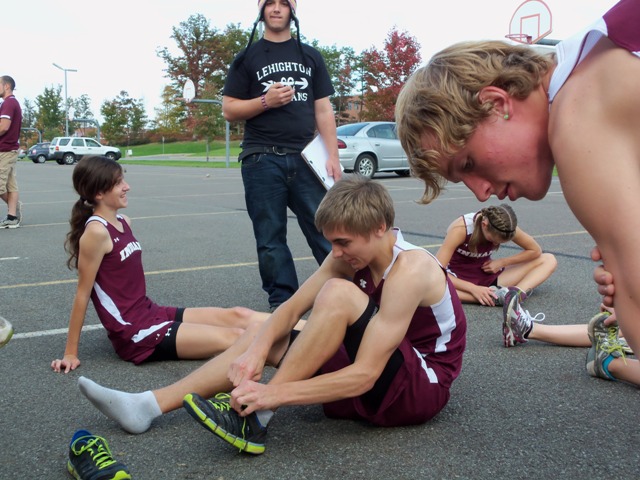
Chris Bosco turns to Daulton Radler and
says, "This is how champions tie their shoes."

Daulton Radler says, "Just watch my back." 
Emily Oldt says, "Yup!" as she laughs.

The Right Stuff?  Some days they never cease to show me they do.
 The Lehighton girls put in a good day on the course today, extending their record to 3-9, by beating both
East Stroudsburg North and East Stroudsburg South in a Mountain Valley match-up near Bushkill Falls today.

Freshman Jeni Beers came in second overall, just ten seconds behind Pocono Mountain East's best runner, Senior Abby Ross.  Jeni had a time of 20:32 her career best time.  Junior Emily Oldt came in 4th overall and second for Lehighton with a career best 21:59, followed by Freshman Cassie Rehnert with 23:03.  Senior Alyssa Schleicher has been turning in good times with some strong running form, helping to anchor the crucial last 2 spots that allowed Lehighton to hold off ESS with a time of 26:36.  Freshman and newcomer to the sport Erica Koutch continues to improve with a 26:58.  Lehighton is looking forward to 3 more years from these talented freshman girls.


Coach Marushak going over passing strategy.  Cassie Rehnert,
Josh Gornick and EMily Oldt say is it enough to take
6 spots in the last mile?

The different ways pre-race jitters can look is evident here.
All those jitters are gone at the sound of "Go!"
Emily Oldt's sneaky, sly form hides her speed.
Daulton is not going to let them stay there.
Eyes up Chris Bosco...good form.


Jeni Beers shows how she uses her arms to pump it up over tough hills. 
The rest show their jealousy with their smiles.


The boys were without all their teammates today and did not have enough to qualify for a team.  They dropped both matches to ESN and ESS.  But that didnt stop them from turning in some season and career best times. 

Daulton Radler had a 19:03, Ryan Coulter 19:57, Chris Bosco 21:06 and Josh Gornick 25:11.

All these atheletes should return and be solid once again for Lehighton.

Determination on Josh Gornick's face.

The methodical steps of a seasoned
senior runner.  Nice run Alyssa!

Erica shows a bounce in her step.

Sophie Coombe was able to knock 30 seconds
off her Middle School race time at this same
course from just 3 weeks ago. 

 <><>
<>
<><>
Ryan had no idea just how fast he could run today.
 As the Mountain Valley League Meet approaches next Tuesday 10/18/11 at Bethlehem Muncipal Golf Course, our harriers seem to be peaking at just the right time for perhaps a medal there and possibly a District berth to the state championships...Keep your eyes on the prize!