"I think of Cal everyday...Even today, each day that man makes me smile...sometimes I catch myself alone in the car, laughing and laughing at something Cal said...People passing me by must think I'm crazy...but they didn't know Cal Haas."
~Dick "Chocky" Semmel, March 2011.
Ahead of his time: Cal Haas, with his George Strohl delivery wagon prior to opening his store on Coal St in early 1930. This photo was taken just south of the corner at Third and Iron Sts, Lehighton. Though he was just a deliveryman for Strohl, Cal had his own name painted over the rear fender.

(This story is a companion piece to another post "From Farmers, To Grocers, To Tire Dealers: They were the enterprising Haas's" can be found by clicking here. There you will find more genaology and a few other stories not found here.)
Haas' Store: the institution, it was the nerve center
of the neighborhood universe at Fifth and Coal Streets in Lehighton.
It was the center of my life.
Cal Haas was enterprising and industrious. He left his family farm in Andreas before he
was ten to live with his older brother Ivan who was a green grocer living on
Ninth St in Lehighton.
 |
| L to R: Miriam, Madeline, and Mildred "Sis" in the earliest days of the store circa 1933. |
All the Haas’s had a dint for hard work and a nose
for business. His father David farmed
but huckstered oysters. Brother Clint
timbered, raised cattle and ran a hotel at New Ringgold (On the same lot as the
mini-mart gas Station is today, at the railroad crossing.)
Davie ran an ice cream shop at today’s “Bridge Street
Hotel.” Jeremiah “Jerry” ran a tire
re-tread business in Allentown and later worked at the Tropical Fruit Store at Sixth
and Tilghman Sts.
 |
| An early picture of Cal and Becky Haas' Store |
 |
| Madeline was a full-time employee most of her life. She was widowed when her first husband Ezra was killed in "Operation Tiger" in the English Channel days before D-Day. (Click here for that story.) |
And two of Cal’s daughters, the two who scoured the
neighborhood with order pads, Miriam and Mildred “Sis,” also had businesses of
their own.
 |
"Sis" working the counter at Garvin's Restaurant at Third and Coal Sts
while her husband Lee Garvin works the grill in the early 1960s. |
“Sis” Garvin ran a restaurant on the corner of Third
and Coal Sts in the 1960s. It later became
the “D&D Print Shop” and is currently “Deet’s Salon.” Miriam ran a cement lawn ornament shop at her
Center Valley home for many years into the 1990s.
 |
| Bread was king, it was the "bread and butter" to most corner stores. Most stores also had these promotional pictures of the store owner posing with "Freihofer's Breads." |
Haas’ Store’s “big bang” was in bread. Cal Haas ran three bread routes for George Strohl. Cal’s first step of breaking from Strohl was
the advent of his own home-delivery of groceries, his “Store on wheels.”
(Cal had a brother-in-law, Raymond Weigner, married
to his sister Sadie, who was also in bread delivery. He was struck by a car and killed in Summit
Lawn, Allentown, just three days after Christmas in 1928.)
Strohl’s cream donuts were said to be particularly
sought after. Miriam remembers George
Strohl to be a tobacco-chewing, unshaven son of a gun who made the best bread
in town (click here to read more of Lehighton’s baking past.)
The early years were harder on the older children
who were fully employed by the store. Madeline,
Miriam and Mildred (“Sis”) went door to door with order pads, writing down orders that would be delivered later.
 |
| Madeline Haas with Cal Haas sedan, with the ever present "rabbit," which is what Haas means in German. |
Cal was known to be a night owl, entertaining other
insomniacs with his stories while he shucked oysters or watched television to
the early morning hours.
Miriam especially felt a great responsibility to her
family’s livelihood. She remembers
leaping from her bed before 7:00am at the noise of delivery trucks. She’d rush down before the delivery was
complete, scrutinizing the actual delivered goods versus the invoice to insure
a fair trade.
The restocking the Haas delivery sedan each evening also
fell on Miriam’s shoulders.
A key friend of Cal’s was William Snyder. Snyder ran a confection and tobacco business out of his
458 Cypress Street home, just down the alley from the store, during the 1920s
and 30s that predated Haas' Store.
 |
| Bill Snyder's Cypress St business pre-dated his friend Cal Haas' Store. This is an ad from the 1928 'Gachtin Bambil,' LHS Yearbook. |
 |
| William "Bill" Snyder and Cal having a weenie roast in "Bill's Lot." The store is in the background. Bill's lot was a favored place to play for many of the Haas children and grandchildren. The lot is now owned by Hilly Haas. |
Ruth Arlene Haas and family would rent the former home of William and Arlene Snyder while the Snyders moved to the rear, occupying the second floor over the confection enterprise. From that point onward, from the 1950s into the 1980s, the Snyders never raised the rent rate, which was $45 per month.
Eventually, the Snyder estate was divided among the Haas siblings, the home going to Ruth.
 |
| George Freeby's own label, here and below. Clever: "Free-B" with a 'bee' atop the 'B.' |
Arlene Snyder was the sister to Progressive Merchant Wholesale grocer George Freeby. Freeby was also Vice President of the Pennsylvania Grocer’s Association and was a founding investor and director of two Lehighton Banks. His warehouse was on Maiden Lane, Lehighton and Cal purchased many of his groceries from Freeby including George's own label "Free-B."
(As children, all of us grand-kids were enthralled to go there for store wholesale orders, going to the second floor to watch the cigarette cartons travel at a high rate, getting their Pennsylvania tax stamps, and then watch as the automated machine folded and sealed up the cartons.)
(George Freeby killed blacksmith Charles Mertz at
Mertz Corner on his way to the Country Club with three friends. Mertz was on the road, as he returned from
voting on November 6, 1928. Freeby was also a good friend of George Rabenold, brother to Zacharias.)

Like most legends, separating Cal Haas the man and
Cal Haas the myth is nearly impossible.
People like Dick “Chocky” Semmel adored him. Cal Haas was an enigma: known for an
unfiltered wit and quirky habits, sprinkled with moments of intemperance, his
behavior yet another testament to why people considered my Grandmother Becky as among the saints.
It is believed Jockey got his moniker from Cal due to his slight stature. However Cal's dutch made it sound more like "Chocky." Dick signed all his cards to our family as "Chocky." And according to a more recent conversation with Chocky, Cal had other mismatches of names, such as "Spencer Tracer" and "Wong Taylor" (Vaughn). He also preferred to call actor Erich von Stroheim that "Bull Neck Turk." Chocky would ask Haas, "Why do you call him that?"
It is believed Jockey got his moniker from Cal due to his slight stature. However Cal's dutch made it sound more like "Chocky." Dick signed all his cards to our family as "Chocky." And according to a more recent conversation with Chocky, Cal had other mismatches of names, such as "Spencer Tracer" and "Wong Taylor" (Vaughn). He also preferred to call actor Erich von Stroheim that "Bull Neck Turk." Chocky would ask Haas, "Why do you call him that?"
Haas: "Because he hassa bull neck like a Turk!"
It wasn't just names Haas would like to butcher, but other names too. Baseball's "Grand Slam" was a "Slam Bang." These peculiar oddities were sometimes hard to decipher and it was not known if these originated as slips of the tongue, or else were just odd quirks of his tangled thoughts. Regardless of the origin, once Cal Haas said it once, it always stuck, and was forever spoken that way by him.
According to Semmel, Cal’s ‘Twain-esque’ humor and insight created ideas ahead of their time. He credits Cal with originating the idea of a hotline between the President and Moscow, long before the Cold War necessitated one. The store didn’t have a warehouse, but it did have a “wareroom,” another moniker that allegedly originated with Cal.
On at least one
occasion, Cal would check-in at his favorite stop, Diehl’s Triangle Hotel at South
First and Bankway. A call would come into the store, “Cal’s too drunk to finish his route,”
and Bobby or Miriam had to walk to the truck and finish the deliveries.
Other times,
Lehighton Officer Robert “Tuggles” Ronemus would bring Cal home.
Undeterred by such setbacks to his fun, he’d
walk back to Diehl’s or to the Eagles club.
Another time, Cal
drove the wrong car home. When Tuggles came to retrieve it, Cal handed over the
keys with a promise to wait until the morning to retrieve his own car.
 |
| Miriam with perhaps Tommy Buck along the Fifth St side of the store. The cellar door at right received stock from truck deliveries. |
And with that promise, the case of Cal’s grand theft larceny was forgotten and forgiven.
Like most corner stores, Haas’ provided store
credit. Customers could put things “on
the tick.” One night of reverie led Cal
to end the inner nagging of some of his longest outstanding debts.
According to Cal Haas lore, on at least one
occasion, he came home assembled about $2,000 of unpaid customer bills and
burned them. To understand the magnitude
of this figure, know that a loaf of bread was under ten cents at this time.
I remember, near the waning days of the store, I made a perusal of the unpaid bills, some reaching back to the 1940s and 1950s. The sum, then once again, was well into the
thousands of dollars.
 |
| Hilly Haas makes a delivery to long-time customer Lavona Ronemus in 1989. |
I can remember being around nine or ten and delivering
one of my first home orders to a neighbor woman struggling with an alcohol
problem who subsequently developed the habit of owning grocery debt.
My uncle’s admonishment and coaching before I left went like this:
“Do not to enter the house and certainly do not let go of that box, until you
have cash in hand.”
I can still see the shock in her eyes as
I took the order back to the store with me.
During my lifetime at the store, I saw how many
people relied on the store for more than groceries. Some like Tex Gilbert came for meat ends
because he had nothing else to eat. The
store would also break a box of butter down to quarters to make it more
affordable for those unable to buy a whole pound. I can still see Oscar Diehl buying one stick and eating it straight from the wrapper like a popsicle.
 |
| Becky's big-heart emerged from a childhood of uncertainty. Her father died was she was in her early teens, forcing her mother and family to move off the farm and into town. She and her mother and sisters cleaned homes and lived with an older couple as caretakers to survive. She married cal when she was just sixteen. Becky with Robert and Ruth behind the store around 1936. |
My mother would often mention how Becky’s generosity
was well known among the collection of hobos who passed through town
among the freight lines of our town’s famed “Packerton Yards.”
Others found an outlet for their gambling needs with
both the Pennsylvania Lottery and in the small bets the uncles covered in the
kitchen, the nerve center of the store.
You could find Bill Bayer and Uncle Hilly covering each other on several NFL games each week at $5 per game on any given Sunday. Each man getting to choose one game over the other.
You could find Bill Bayer and Uncle Hilly covering each other on several NFL games each week at $5 per game on any given Sunday. Each man getting to choose one game over the other.
The front counter had a doorbell button connected to
a buzzer when assistance was needed from one of the Haas men who were posted
for duty at the meat counter but whiled away their time, with foot on the
former table of Becky and Cal, watching TV between customers.
In the 1930s and 1940s, and even into the 1950s,
only about half of the neighborhood had a telephone. The store served as a vital communication
center, relaying messages from relatives far away.
Railroad dispatchers too, called the store when they
couldn’t find one of the many railroad workers for an assignment. Many times the Haas children were enlisted to
find these trainmen to get them to their posts.
Cal put most of his drinking behind him by the
1950s. However for one occasion, the
wedding of his daughter Ruth, he reached deep down for a good one. His jag included the theatrics of accusing
his son Robert of bilking him for over $60,000.
 |
| Cal, back center, with son Bobby holding hat. |
Cal and Becky enjoyed Sunday afternoon excursions to
the “Ridge Cup,” along present day Route 309, back near his old homestead. They’d pack Becky’s knitting and Cal’s rubber
ball, and of course his favorite: a thermos of oyster stew. Cal would find a nice flat spot to bounce his
ball.
He was known to have bounced a ball a million times on at
least three to five separate occasions. He kept
records of it in his safe. One day a disbelieving
salesman asked to see the records but only saw Cal’s fury when it appeared that
someone had gotten in the safe and thrown the records away.
 |
| "Johnny's Produce" - Seen here delivering produce to Haas' is Johnny's Produce worker "Ray" who was a well known door-to-door peddler in Lehighton in the 1960s/1970s. Johnny Knauss, had a produce shop on North First St below Carbon St. He ran it into the 1980s, long enough for the grandchildren of Cal (like this author) to be old enough to drive there produce order pick-ups for the store. |
He’d save his money for various things in unique ways. He had a tire fund, a tax fund, a deep sea fishing
trip fund and what have you. After the
total was determined, he’d calculate the thickness in quarters or half dollars
to reach his monetary goal. Then he’d
cut pipe to the length necessary.
Once the pipe was full, he knew he had the right
amount. He’d do the same thing by calculating
the volume of glass jars and cans as well.
All the while, he kept his accountings on pieces of butcher paper slung
across the hallway wall, hence you could say Cal was first to utilize “spreadsheets.”
(I remember my mother saving for my sister’s
orthodontic braces in the same way with her tip money from waitressing.)
 |
| David and Mary Alice Haas on one of their two farms they lived at in Andreas. A fire necessitated their need to find a second home. This picture most likely late 1920s. |
Sometime in the 1920s, Cal’s parents David and Alice
moved to 222 South Sixth Street to semi-retire.
David still huckstered oysters nearly up until his death in 1937.
Cal’s store was underway and he took over more and
more of the oyster business as his father’s health faded. Many of people who stopped by the store
watched him sort the stewers from the fryers, carefully saving the juice, dropping
the shells through a hole in the counter he special built for oyster shucking.
Some of the shells made their way to the chicken
farm across from the present day high school which had a hammer-mill for cracking down corn and oyster shells to be mixed into chicken feed.
 |
| Bobby behind the counter of the store near the end in 1998. |
Other shells were used as fill for the dirt alley
leading down to Cypress St where I grew up, in William Snyder’s old home. Even though the alley was paved in the early
1980s, you could still find chunks of oyster shells there until recently.
Besides my cousins and the constant homecoming parade of old friends, there was always a colorful array of characters dropping in, much
like Jerry Seinfeld’s apartment. They
always had a new dilemma, a new story, a new heartache to discuss, or just to
simply sit in silence across the kitchen table at the rear of the store.
 |
| Tough Girls: One of my favorite pictures of my aunts, epitomizing their witty charisma: Aunt Miriam Haas waving from her thumb to Aunt "Sis" second from right, with their friends Claire Parish Whitehead sporting the Winston Churchill "victory" sign and her future husband's sister, Melba Whitehead. |
A partial list of real people here: Earl Simmons,
Tommy Buck (Aunt Miriam still fawns for his ever so white teeth), Attorney
Bayer, Wimp Nothstein, Tex Gilbert, Richard Herlihy, Tom Polk, the Kostaks, Dorthea
Xander, Bill Blocker, Jimmy Murphy, Wesley Bowman and etc.
For me, it was a place to belong. And It was a center of my learning too. Chiefly, I learned the value of hard work. But ever so subtly, it is where I learned how a family can work together as well as argue like enemies.
The Uncle Bobby vs. Uncle Hilly fights were epic. Poor Hilly, forever the “little brother,” could seldom do right in Bobby’s eyes. Visible through that ever settling debris field of family dust-ups, one could still find the love instilled through the ages of family.
It is where I realized you didn’t have to always
like your family, and yet you never stopped loving them. As I’ve aged, one of my favorite
“compliments” from my own brothers, when we’re fighting, is that I’m just like
Uncle Bobby.
 |
| Bobby Haas's lottery permit originated in 1972. |
 |
| Six of Seven of the Haas Children: Mildred, Miriam and Madeline fronted by Hilbert, Ruth, and Robert. BetteMae, the youngest is not pictured. |
The store was a place to spend many hours with my aunts and uncles: Uncle Bobby, Uncle
Hilly, Aunt Madeline, and Aunt “Sis” (Mildred). Additionally, there were the many deliverymen I
looked forward to seeing each week.
There was the 7-Up man who controlled his blood pressure
herbally and smelled so strongly like garlic, that he forced everyone to hold their breath until he left. And once he did, the store was properly aired out.
There was Ernie Long and the Zimmerman’s Dairy
truck. Ernie was among the many
deliverymen who’d let me sit at the wheel, pretending to drive, honk the horn and flash the
hazard lights as they completed their delivery.
The Tastykake man would bring me Phillies schedules
on little cardboard cards, the home games listed in red ink on the front, away
games were in blue on the back.
And of course there were the best delivery day of them all: Thursday mornings between
8:30 and 9:00am, "Trexler Park" day. Trexler Park was a major distributor and wholesaler to small grocery stores. To me, it was nearly as anticipated as Christmas day. (See “Epilogue” for more on this.)
 |
| Robert Haas with some Krakow Polish Ham - 1970s. |
My earliest sin and lie that I can remember was
committed there. Uncle Hilly just
returned from Johnny’s Produce on North First Street with a box of tomatoes.
I promptly remember sticking my fingertip into one
of them. There was a tactile thrill
here. So I did it again and again, until
the whole top layer of tomatoes was ruined.
 |
| View of aisle leading to the kitchen, the Chip and Tasykake shelf, foreground right is where Cal and Becky's stairs once made their descent. This left side of the modern store was originally downstairs living space. |
I can remember the anxiousness on Hilly’s face when
he called me into the wareroom, alone.
My heart sunk as my fears were confirmed with the presentation
of the key evidence against me: the damaged tomatoes.
Scared to death, I lied. I was released and went down the alley home.

And in my little six year old heart, I knew he had
me. Mea
culpa! I had nothing left to do but
to break down.

The store was a constant stream of the off-color story,
adult jokes, and the zany, unfiltered humor of the Haas family and customers
alike.
There was a stack of my uncle’s men’s magazines,
carefully concealed in the wareroom that certainly opened my young eyes. I can also remember being shown the picture
of a close relative who unabashedly sent her own picture into one of the amateur sections of one of those magazines. (Uggh. I don’t even know where to begin to heal
those scars.)
 |
| Katie Nothstein Boyer with her sister Becky Haas. Cal always teased about Aunt Katie. |
Though he had just a third
grade education, Cal was an avid reader. He loved, probably in this order: greasy foods, Friday night boxing on
TV, and of course his wife (though often joking how he married her only to get
closer to her sister Kate).
Benches were set up on the porch and the TV was brought outside. The fights drew crowds to the only TV set on the block.
Benches were set up on the porch and the TV was brought outside. The fights drew crowds to the only TV set on the block.
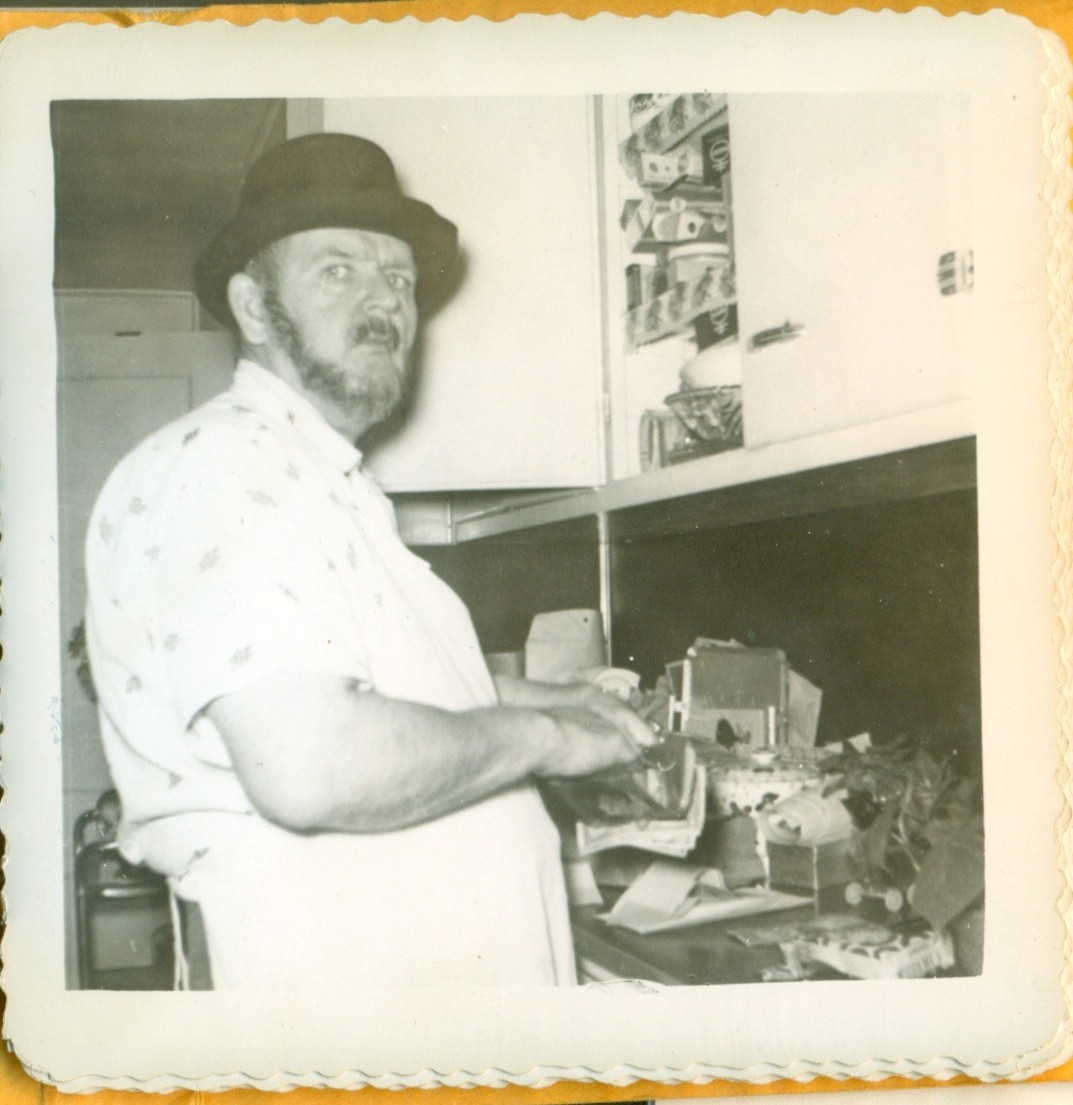 |
| Cal with money in the kitchen: Cal's unpredictable wit and deadpan stare was known to scare people at times. There was one smooth-talking sales person who would visit, ask to use the upstairs bathroom, and on at least one occasion, cleaned Cal and Becky out of their personal cash from their bedroom. |
But it was his wit and charm that amassed the loyal
friends like former Lehighton resident Dick Semmel.
With a capriciously sharp wit and a shotgun leaning
against the back kitchen door, Cal could also scare people too.
He once literally caused a woman to faint in the Street. And on at least one occasion, Cal made threats toward his one daughter who still remembers the menacing voice and expression to this day. Those words if taken literally would scare anyone. But knowing the hyperbolic Cal, I'm certain it was all in dark fun.
He once literally caused a woman to faint in the Street. And on at least one occasion, Cal made threats toward his one daughter who still remembers the menacing voice and expression to this day. Those words if taken literally would scare anyone. But knowing the hyperbolic Cal, I'm certain it was all in dark fun.
Cal indulged in staying up late and eating fatty
foods, like fried summer sausage. He refused to interrupt his mastication for the
grease running out and down the corners of his mouth.
Many have attested to Becky’s saintly big heart, Dick
Semmel and recently deceased Bill Blocker of Lehighton among them.
She took a steady decline due to Parkinson’s disease
and died in an Allentown nursing home in 1969, her mind nearly gone due to
dementia.
The late nights and poor diet caught up with Cal
too. The diabetes soon took his leg.
To boost his spirits, his son Bob and Dick “Jockey”
Semmel took him for a ride, out past the old Ridge Cup, past his brother
Clint’s old hotel and when they got home, they all had some oyster stew. Seeing the old sights did much to lighten his mood.

But on June 28, 1967, Cal felt the pain in his arm that
prompted daughter Madeline to take to the Lehighton Hospital. Soon
though, the doctors and nurses discovered the Haas humor, and all seemed to be
all right.
Feeling better, Madeline left him with the staff to
phone the store to tell everyone Cal seemed to be fine. But during that call, his heart arrested and
Cal Haas was no more.
The store made it through another thirty years with
son Bob. He expanded the building, and for a time, it thrived, despite the introduction of the
big supermarkets of the 1970s.
And so it goes. But memories linger on.
Oyster stew remains as one of my go to comfort foods to this day. It seems to do so for untold and unseen reasons.
Oyster stew remains as one of my go to comfort foods to this day. It seems to do so for untold and unseen reasons.
Studying this story of my past connects those
threads, the love of oysters going back to my great-grandfather, Cal’s father
David, born over 150 years ago.
It’s funny how the small subtle pleasures that we
gain throughout our lives gain clarity as we age. Having grown from a boy to a father of grown
children myself, I can to see and taste my mother’s oyster stew, stretched out
over time.


 |
| The Store: the 1950s version above, 1970s below. Note the vintage 7-Up machine cut-off left, below as well as the exterior porch and stairs cut-off at right, and of course the expansion of the store to fill the entire downstairs. These are the most notable changes Bobby Haas made expanding the store from the family residence to a more "modern" corner store. |
 |
| Changing times: the "Cigarette Permit" of 1953 evolved into one owned by both Robert and wife Geri by 1958 (below.) |


 |
| Always popular with kids for sodas and snacks, especially during 6th and Coal baseball season. Workers at Tom's Sportswear and Scotty's garment mills also relied on Haas' for lunch and break items. |

~Not only did Semmel make a career in the military, volunteering for combat in Korea once and two times in Vietnam, but as a result, has lived a well traveled in rich life. He has set foot in every country of the world save three. That's right, 193 of the 196 countries. The only three countries he has yet to visit are Afghanistan, Pakistan, and the small, southern, land-locked African country of Malawi, which would be an 18 hour trip, and when asked, said he most likely would not visit there. He still holds hope to one day visit the other two. Chocky is now 88 years old (as of August 2020).
~Please feel free to reach out to him at his home in Ohio - (937) 873-8658. 2270 Park Hills Drive Suite #117, Fairborn OH, 45324-5936.
Trexler Park Day:
His name as I remember it was ‘Bill:’ This big-jawed, scruffy-faced, cigarette smoking, hoarsed-mouthed, laughing man brought that sixteen-wheeler along the Fifth St side curbing each Thursday morning around 9:00.
The street would be cleared of cars from the burn
pit to the corner to make way. He’d
parallel park so that his side door opened to the cellar door, and the skate
wheel conveyor was set up. Almost always
it was Uncle Hilly at the bottom catching.
Early on, it was a thrill just to be in the truck
while “Bill” set the stuff down.
Occasionally he’d miss-time Hilly’s return, sending a case of Maxwell
House Instant coffee in glass jars crashing to the cellar floor. But maybe not so much so accidentally, the
big box of Bounty towels inevitably always one of the last items sent, was sent
to the floor.
 |
| One of the favorite pastimes of the many grandchildren and stock-boys was writing graffiti and stories on the cellar stairwell. Fights between Hilly and Bobby gained permanence here, documenting how one fight erupted over the placing boxes on the stairs in a "wrong" manner (top right). Some of the writings extended past the stairs onto the surrounding beams in the cellar. These markings are still preserved despite major renovations to the building. It is now owned by the Larry Markley Nationwide Insurance Agency. |
Eventually I got big enough to release the boxes
from the top and I loved sending the paper towels flying without Hilly to
receive them. And then, perhaps by
around ten years of age, I Started helping Hilly catch the boxes. I had to work up to the big and heavy boxes
of laundry detergent, but eventually I could do those and the boxes of Campbell’s
Soup and everything.
The store passed from my grandfather Cal to his son
Robert in the 1960s. Robert expanded the
store drastically: knocking down the wall that separated the Haas family living
space of the left side of the house and taking out the interior stairs to the
upstairs. The former second floor living
area was now an apartment accessible only by an exterior set of stairs.

One kooky employee was my Aunt Madeline’s second
husband Chester. (Her first husband, hertrue love, died in the English Channel at the hands of a German schnellboat. Read his story by clicking here.)
 |
| Around the kitchen table at Haas's: BetteMae, Bill Snyder, Sis, Becky, John and Miriam, Bob and Geri, and Arlene. Chester wears the vest and Cal front and center. |
Chester, also a WWII veteran, had many compulsive
habits. He believed in living out literal
biblical pronouncements and kept separate places for his and his wife’s foods. He constantly monitored the distance from the
back of their cupboard to the stacks of their dishes.
He also once set out to cross Pennsylvania by
foot. After crossing a bridge of the
Delaware, his determination was stilted after a few miles of blisters from his stiff
new leather dress shoes.
His phone call
was to Becky at the store, mustering only the words, “Mam, I failed.” The newspapers proclaimed, “Five Miles and
Ouch (Out)!”
Chester was the shelf-stocker long before the days
of the grandchildren stock-boy generation came along. His
precision and attention to detail was unmatched. But to his chagrin, it was near impossible
for him to ever quite finish the job.
If he neared the end of his stocking and if there
were customers still shopping, Chester’s world would get stiflingly
frantic. As each gap appeared from this
missing can or that missing box, Chester would dutifully descend the stairs for
a replacement, one can or one box at a time.
This customer-stockboy cat-and-mouse was said to go on for hours.
 |
| Most of the oldest generation of Haas grandchildren at the annual Haas family Christmas Eve Party mid 1960s- Starting back Left: Brenda Garvin, Debbie and Kathy Haas, Randy Rabenold with Jimmy and Jeff Garvin. Susan Haas is cut-off front center. |
The Break-Ins:
In the 1980s, a local man, well-known to everyone in the Haas' Store neighborhood, began to have a series of run-ins with the law. During his time "on the lamb" he used the store as a 'home-base' of sorts.
Because he couldn't show his face in the day hours but still needing sustenance, the man would find easy egress into the store by pushing one of the exhaust fans aside that simply sat in front of the open cellar windows.
He generally took cigarettes and lunch-meat, but on at least one occasion wrote a note, with an apology and thus gave a fair accounting of the items he took.
The man also knew of Hilly's habit of leaving his keys in his station wagon. At first, the man took the care on rare or perhaps desperate occasions when he needed a ride someplace.
I remember on at least two occasions driving around in Dick Herlihy's taxi with Uncle Hilly searching for his car.
But the joy-ride that took the cake was the night the man, in some sort of anger toward his car-loaning benefactor, decided to ditch the car, front end into the Mahoning Creek.
I can still picture the sweep of the headlights as we turned into Baer Memorial and how they found the wagon at a pitched angle in the water. And despite our best attempts at gunning the engine and spinning tires, it just wouldn't budge.
The break-ins continued over several weeks. And thus began a rather long series of measures to stop them, including some diabolical "Home Alone"-style booby-traps at the cellar windows, reinforcement of interior door from the cellar and even late night stake-outs on alternating nights between Hilly and Bobby. Cousins even sat in the store, in silence, each night through the small hours of the night.
Finally, one evening, when Bobby was on post alone, the mouse had entered the trap. A slight scuffle and perhaps a shot from a revolver (this fact has strong confirmations though it was later disputed as happening), and the fugitive tore off through Bill's lot.
Word passed on the town police scanner and some residents in the know went on alert. It was local Power and Light Manager Lonnie Armbruster who apprehended the man hiding in his mother's shrubbery near Sixth and Cypress Sts.
In the 1980s, a local man, well-known to everyone in the Haas' Store neighborhood, began to have a series of run-ins with the law. During his time "on the lamb" he used the store as a 'home-base' of sorts.
 |
 |
| More Grandchildren: Brenda Garvin helps with Jacqueline Parker's socks at the store 1950s. |
He generally took cigarettes and lunch-meat, but on at least one occasion wrote a note, with an apology and thus gave a fair accounting of the items he took.
 |
| Rebecca Haas saw to it that her children, and thus her grandchildren, were raised with an abiding faith within the teachings of a Mennonite based, Salem Bible Fellowship Church. Here is the wedding at the Cypress St Church in 1951 for Miriam's wedding to John Parker. The Jesus as Shepard painting in the background was relocated to the new church now in the Mahoning Valley. Becky was strongly assisted in this en devour through the efforts of Arlene Haas. |
The man also knew of Hilly's habit of leaving his keys in his station wagon. At first, the man took the care on rare or perhaps desperate occasions when he needed a ride someplace.
I remember on at least two occasions driving around in Dick Herlihy's taxi with Uncle Hilly searching for his car.
I can still picture the sweep of the headlights as we turned into Baer Memorial and how they found the wagon at a pitched angle in the water. And despite our best attempts at gunning the engine and spinning tires, it just wouldn't budge.
The break-ins continued over several weeks. And thus began a rather long series of measures to stop them, including some diabolical "Home Alone"-style booby-traps at the cellar windows, reinforcement of interior door from the cellar and even late night stake-outs on alternating nights between Hilly and Bobby. Cousins even sat in the store, in silence, each night through the small hours of the night.
Finally, one evening, when Bobby was on post alone, the mouse had entered the trap. A slight scuffle and perhaps a shot from a revolver (this fact has strong confirmations though it was later disputed as happening), and the fugitive tore off through Bill's lot.
Word passed on the town police scanner and some residents in the know went on alert. It was local Power and Light Manager Lonnie Armbruster who apprehended the man hiding in his mother's shrubbery near Sixth and Cypress Sts.
 |
| Bobby removes the letters in 1998. |
The Eventual Demise:
 |
| Bobby and Ruth middle 1930s, at the rear of the store prior to the building of the "wareroom." |
Family stores and businesses were under pressure for some time. The Carbon Plaza Mall’s advent in the 1970s introduced the area to its first “supermarket.” And later the 1990s saw the coming of Walmart. First Street’s A&P market accepted defeat a few years before Haas’ eventual end.
The small furniture store
of Mel Everett on Third
St., formerly Trainer’s Grocery, is gone.
Along with Kirkendall’s Dairy, Ice Cream and grocery on South Second St.
and Lou Volkert’s dinette counter and grocery on North Second.
 |
| Madeline (rear) and Bobby (ground) hamming it up behind the store. |
Gone too are Bennett’s Candy Shop, Levine’s
Furniture, the Lehighton News Agency as was as Hammel’s store which was a news
agency and dinette at the bottom of Coal Street. And today we are saying goodbye to Lehighton
Hardware.
I started at the store on my own volition. I didn’t do it to seek a salary, but rather
because it was something fun, a hobby.
It was a chance to be with those zany Haas’s worth more than change my
aunts and uncles could put in my pocket.
I remember simply sitting up front, next to Aunt
Madeline or Sis, waiting to be of service: bag five or ten pounds of potatoes,
filling up the Lifesavers or Hershey bars running low, the extra stock beneath
the counter, assessing the stockpile of bags: two, five, eight, twelve, twenty
and the largest ones, the “flat-bottom” bags, and running to the cellar for
replacements.
I made the “payroll” sometime around fourth
grade. I was allowed one returnable,
quart-bottle of A-Treat (almost always “Cream,” but sometimes “Grape” or “Birch
Beer”). I was also allowed one small bag
of chips, usually “Wise Onions Rings.”
But soon my best hopes were answered when Hilly’s
high-school age son Kenny gave up his duties of burning trash and carrying up
the “List.”
 |
| Stock storage in the basement. The stock needing replacing was placed on a 'list' by Hilbert, then he would place the items into boxes that were placed on these stairs. The carrying of these boxes up by stockboys like, Jimmmy and Jeff Garvin, Kenny Haas, and last Rick and Ron Rabenold was known as 'the List.' The "Dollar Days" canned food sales required much heavy lifting. The area to the left was where Cal had his oyster shucking table as well as his barrels of molasses that according to Delbert Haydt, Cal once fell asleep mid-tap, pouring a hundred gallons of the sticky stuff all over the floor. Bobby also recalled times when these wooden barrels broke upon the cellar stairs mid-delivery, causing a similar sticky situation. |
At first it was $5 per week for burning the trash on
most days (never on a Sunday or when the neighbors had wash hanging to
dry.) Then it was increased to $7 when
the “List” was added. But the biggest
promotion to my young heart was around Junior High, when my handwriting was
deemed good enough to price the stock: 33 cents for a can of Campbell’s Tomato
Soup.
The work was nearly worth the reward to my best friends
as well. Something akin to Huck Finn,
I’d recruit one of two friends to help me carry boxes up from the cellar. After which we’d share the A-Treat soda from
the bottle, enjoying Hilly or Bobby’s company in the kitchen.
The End of the Institution:
The End of the Institution:
Upon entering the kitchen you could count on seeing
at least one of two things: Uncle Bobby, with his nearly perpetual cigarette or
Uncle Hilly, his right foot up on the table with a patch of Lipton iced tea in a glass half-gallon orange
juice bottle.
 |
| Hilly in a familiar pose in the kitchen between meat counter customers. |
The “List” was each Monday and Thursday. Hilly would appraise the stock on all the
shelves, make a list, and collate the assorted cans and packages into boxes and
place them on the cellar stairs to be carried up.
Early on, I can remember the stairs being quite
full, with only a narrow walkway down the center, some of the boxes were piled
two high across the nearly four-foot wide treads. But these piles also served as a barometer of
the store’s failing business, getting appalling scant as the 1980s turned into
the 90s.
Cal Haas's son, Robert "Bobby" Haas closed the store in 1998.
The two sisters most associated with the store, Madeline and Sis are both gone. Madeline in 2008 and Sis in 2011.
Though Bobby suffered and conquered several open heart surgeries from the 1970s he lived into his own 70s.
He struggled for several months after a complicated aneurysm surgery and passed in April of 2012.
 |
| After the sale of the store, Bobby and other relatives were on hand on the day when the new owners demolished Cal Haas's "wareroom." Found amid the wreckage was the maroon toilet seat. |
Cal Haas's son, Robert "Bobby" Haas closed the store in 1998.
The two sisters most associated with the store, Madeline and Sis are both gone. Madeline in 2008 and Sis in 2011.
Though Bobby suffered and conquered several open heart surgeries from the 1970s he lived into his own 70s.
He struggled for several months after a complicated aneurysm surgery and passed in April of 2012.
The last of Cal and Rebecca’s offspring who remain
are three: Second oldest Miriam just celebrated her 90th birthday,
while the two youngest, Hilbert and BetteMae are still alive and healthy.


 |
| Top: The Haas siblings from one of the traditional Uncle Bobby's Christmas Eve parties in the 1970s. Mid: From the later years "themed parties" organized by "Sis" Haas's daughter Brenda. This one a "Black and White" party. And here at Bobby and Gerri's 50th Anniversary: Miriam, Ruth, Bette, and Madeline with Bobby and Hilly, late 1990s. |

 |
Madeline and Mildred "Sis" Haas were the two Haas sisters who are most known for working the front counter of the store. Forever taking trips and having themed parties together, here they are in their retirement years above and as Devil and Angel below. |
 |
| This tranquil winter scene of Lehighton taken from the second floor window looking toward the Lehigh Gap with Zion's clock tower and Trinity's steeple. This background compares to the one in the picture of Bobby above. This post was posted at 8:00pm, the time the store closed each night. |


