Showing posts with label josiah white. Show all posts

Saturday, May 15, 2010

Josiah White - He Was the Hand That Rocked the Cradle of the Industrial Revolution


He was born in Mt. Holly New Jersey on March 4, 1781.  By 1810, he had a simple goal: accumulate $40,000 in wealth, and retire to a quiet farm life by the age of 30.  By the age of 28, he had his money and purchased a farm at the falls of the Schuylkill River.  A devout Quaker satisfied to follow the will of his Maker he was set for a quiet life.

Thankfully to all of us, the nation over, Josiah White did not rest there.  Without his foresight and innovation, this area and this nation would not have reaped the economic effects of the industrial revolution and we would not be enjoying the accumulated wealth we have today.

White and a man named Erskine Hazard had a wire mill in Philadelphia that was hurt by Jefferson's embargo and Britain's blockage of the War of 1812.  Determined not to allow a foreign power determine our supply of fuel again, he sought an alternative domestic energy source our nation's growing industries could depend on.  By 1817 at age 36, he arrived in the Hauto and Mauch Chunk area to inspect the coal lands with Revolutionary War Col. Jacob Weiss.

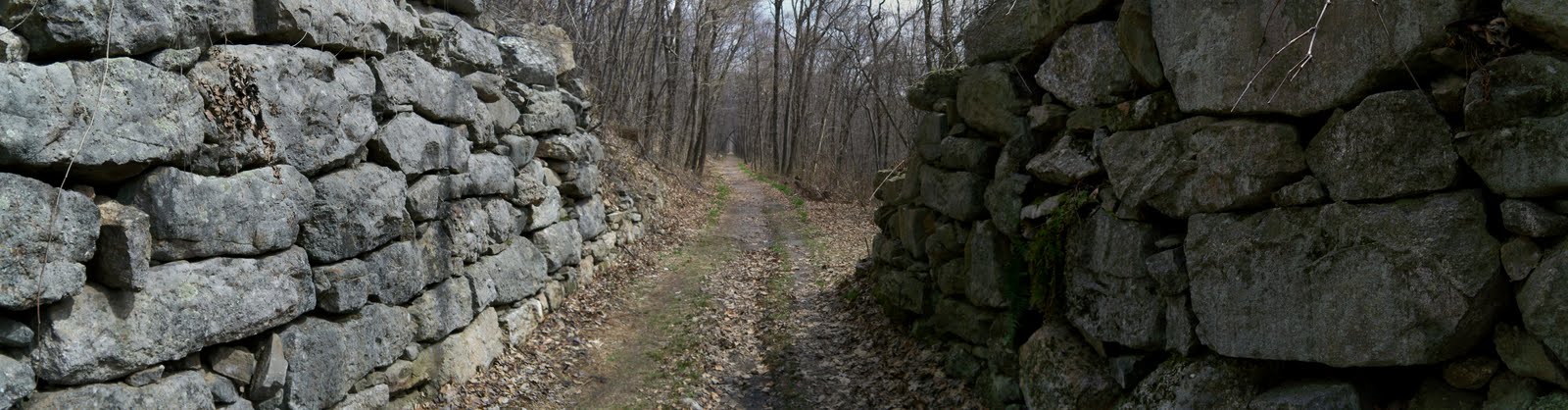
By 1818, George Hauto, Hazard and White had successfully obtained the rights to the Lehigh River for the transportation of coal.  White himself surveyed what would become Pennsylvania's first railroad and would eventually lead to the birth of the town of Mauch Chunk.  This gravity railway was constructed from Summit Hill following the Mauch Chunk Creek for nearly the entire 9-miles.  Eventually, engine houses were placed atop Mt Pisgah & Mt Jefferson for the return trip, creating the first roller coaster.  The picture above shows the stonework of the crossover about 4.5 miles west of the Mt Pisgah plane in Jim Thorpe.


Pictured here is one of White's numberous inventions. This is a model of the Bear Trap lock that White built to tame the Lehigh River to get the coal to markets.  According to Vince Hydro, noted White historian, White experimented with this dam and lock system along the Mauch Chunk Creek near present day Opera House.  Not to encourage the curiousity of the passersby, they were told they were working on 'bear traps' and most went about minding their own business.  (Mauch Chunk Historical Society and Opera House website.)

This lock system dammed the river to make slack water to make the river more navigatable for the arks carrying the coal.  But a method was needed to have the arks portage these dams.  This necessitated White's genious.  Water pressure from behind the dam would fill chambers that held closed the lock door.  When arks were ready to pass through, the water was shut out of the chambers, releasing the lock door for the ark to pass.  The surging water through the lock sometimes caused the arks to knock their operators right off the boat.

The impact of this industrial leader lives on.  Upon his return from a Society of Friends yearly meeting, and for the purpose of setting up an orphanage/training school in Richmond, Indiana in 1850, White died of typhoid.  He left a lasting impact on the economy of the United States and upon Carbon County, Pennsylvania.

Thursday, May 6, 2010

Carbon County Fuels Industrial Revolution, Lehighton Students Learn

It always starts with a problem.

How do we engage our youth?
How do we ply them from the techno gizmos and introduce them to the outside, to engage that exploring spirit?

Perhaps the answer lies within the man who seemed to have a great combination of imagination, energy, and focus.
His name was Josiah White and he was born in Mt. Holly New Jersey in 1781.

He grew up on a farm and explored the surrounding waterways.  One can only imagine what dreams he dreamed.  But he explored, he imagined, he innovated.  The result, some have said, that it became his hand that rocked the cradle of the Industrial Revolution.

Josiah dreamed of riches, enough to retire by age 30, to live the will of his maker and retire to the quiet life of his farm.  He had those riches by the time he was 28, he owned a wire-mill in Philadelphia and fortunately for us, he continued on. 
The War of 1812 taught this Quaker, that one shouldn't rely on a foreign fuel supply.  The British blockade and embargo hampered our industrial output.  And soon, Josiah was planning and surveying Pennsylvania's first railroad, the second oldest in the country.  By 1818, he set out to do what two other groups had failed to do: bring the rich hard, blue burning anthracite down from the veins of Summit Hill and Lansford.
The Switchback Railroad was also our first rollercoaster, reaching speeds in excess of 50 miles per hour.  It was innovative.  It was brought to us by an engaged mind. 

And today, the youth of our county have seen with their own eyes what started with one man's imagination.  Students from Lehighton Area Middle School, recently walked to the top of Front Hill, Jim Thorpe and entered the Switchback trail.  They saw where the train station rested atop the long embanked walkway.  They imagined the clickity-clack of the cars ambling down the 9-miles from Mt Jefferson and later heard the actual engine house bell ring.  They explored and hopefully ignited a life long quest for thinking, for innovating in their own lives.
They arrived at the Mauch Chunk Museum and Cultural Center (See: http://mauchchunkmuseum.com/ ) and were thrilled to see in miniature, the entire Switchback, including it's engine houses and some real artifacts.  Mike Nonnemacher made the journey come to life: how the barney cars pushed, how it was America's second leading tourist attraction (behind Niagara Falls), how it fell to disrepair in the Depression, sold for scrap, and "came back as bullets" when it was bought by the Japanese in 1937.

How do we engage our youth? It all starts with a problem. Do we have the energy and focus to overcome it? Hike the trail. Engage them. Perhaps what started so long ago may help spur a youth's future innovation.  Perhaps new entrepreneurs are now ready to pick up Josiah's mantle. 


Over 50 students and parents of 5th Graders at Lehighton Area Middle School have set out on four tours of the trail, immersing themselves in our partially forgotten history.  Three more evening tours are scheduled. 

The Mauch Chunk Historical Society also sponsors history tours of Jim Thorpe as well.  These local-historian led tours meet at the NJC RR Station every Saturday and Sunday at 11 AM, 1 PM, & 3 PM.  Donations are $10 per adult & $5 per child under 10.  Bill Allison is in charge of the tours and you may contact him at 610-457-0370.  If you would like to know when I am scheduled to give these tours, you can contact me at rabenold@ptd.net or C. 610-428-6651. 

Friday, April 9, 2010

America's First Rollercoaster: Biking Along the Switchback Railroad


This is a view from the far trestle buttress atop the Mt Pisgah Plane.  Visible here, beyond the Flagstaff "Ballroom in the Clouds" at the tips of the branches on the right, you can see the Lehigh Gap through the Blue Mountain.  You can also see the many Dogwoods now in full bloom, along Route 209/The Mansion House Hill, entering Jim Thorpe, below that you can see the Lehigh River, snaking past St. Mark's Cathedrel, a European-style gothic masterpiece of architecture, endowed by Asa Packer.

The Switchback Railroad was the world’s first rollercoaster. It brought the coal from ‘coal country’ of Summit Hill, where coal was first discovered by Philip Ginter in 1791. It was the brainchild of Josiah White to bring the coal down to Mauch Chunk and the Lehigh River and on down to his and other factories of Philadelphia, eventually fueling the industrial revolution’s growing energy demands of the world.


It was the first man-made contrivance that allowed man to travel up to 60 miles per hour. An engine house atop Mt Pisgah, pulled the cars up over 2,000 feet of inclined plane, on down by gravity to the base of Mt Jefferson in Summit Hill and pulled over 1,600 up another plane, loaded with coal, and again down by gravity’s lure to the coal chute in old Mauch Chunk.

Today, one can bike this entire loop and see views from spectacular vistas. These views alone are worth the trip to Carbon County. But back in the 1870s to the 1930s, when this was the second largest tourist destination behind Niagara Falls, people flocked for the unbridled manifestation of White’s inventive mind. You can see the only working scaled replica of this railroad at the Mauch Chunk Museum and Cultural Center, Broadway, Jim Thorpe.

Seen here, is the 5-mile Crossover, looking downhill toward JimThorpe.  This buttress held the trestle for the tracks headed toward Summit Hill and the Mt Jefferson Plane, traveling from left to right.  By mountain bike today, you can head to the top of Mt Pisgah 4.5 miles away by heading uphill to the left of this buttress.  Going straight ahead into this picture, you can find a lazy 5 mile ride along Mauch Chunk Lake and Mauch Chunk Creek, into downtown historic Jim Thorpe.

Monday, April 5, 2010

The Upper Grand Near Penn Haven Junction - Lehigh Gorge State Park

For an extensive look at the Lehigh Gorge River Trail click here for a virtual tour.


After Josiah White and Erskine Hazard built the canal from Mauch Chunk (now Jim Thorpe) to Easton, they worked to provide coal transport from White Haven on down to the harbor of Mauch Chunk. This was done by way of damming the Lehigh River, then creating gargantuan


A residence as was part of the once remote outpost along the CentralJersey mainline heading west.  For more in-depth look at the Penn Haven Junction and Planes, click here.

locks that dwarfed the height of the Lower Lehigh Canal.


These foundations can be seen just north of Penn Haven Junction on the Lehigh Gorge. According to one Central Jersey map, these walls were once part of a residence here at this lonely spot.  was the foundation of a large ice house or cold storage or perhaps it was a residence. I found old solid copper wire that could have been telegraphic wire or clothes hanging wire to the rear.

The spring carrying through this area over the years has certainly contributed to the notch the structure rests in. And currently with the Spring thaw underway, the spring is flowing well and through the remains. Whether this was the course of the spring years ago is uncertain. Higher on the hill and when facing west, the spring flows on the left side. As it approaches the foundation, it turns to the right. There is a large mound, covered in ferns in the summer that sits directly behind it. Whether it be man-made or a nicely rounded rock slide I cannot tell.

In this view, up the hill now, looking down at the remains, looking toward the east, you can see the Lehigh River in the distance, at the bottom of the east side of the Lehigh Gorge.  (White water can be seen in the swollen Lehigh River past the pine on the bottom left.)
It is a mystical place, with the greenest of green moss I’ve seen.


Sunday, March 7, 2010

Mount Pisgah and the Switchback Railroad - My Sunday Hike

I simply love this area.  Its rich history makes for a beautiful place to live and play.  And with warmer air and higher light, what better place to take a late winter's hike, as I did today.  (Check out my YouTube video from opposing mountain...Mount Pisgah plane is quite visible http://www.youtube.com/watch?v=oJGSv-d947M .)

 
When you reflect on the importance of this area in fueling America’s industrial revolution, on the backs and ingenuity of Josiah White, Erskine Hazard and later, Asa Packer, you learn to appreciate this place we live even more. To take in some of the same views they did, you can perhaps have a little inspiration of your own.

One amazing piece of our history is The Switchback Railroad. It was one of a kind. Not only was it key in delivering coal, but it also became our nation’s second biggest tourist attraction behind Niagara Falls.  It is also said to be the first man-made contrivance to excede 55 miles per hour and has been cited as the inspiration for the rollercoaster.
President Uylsses S Grant and Thomas Edison were said to have traveled here to ride it. Today, expert mountain bikers ride it for some of the same thrills as years ago.

Empty coal cars were pulled up the Mt Pisgah plane. Cresting the top, they would traverse this trestle as they began their descent down the other side to reach the base of Mt. Jefferson at Summit Hill. Again the cars are pulled atop another plane, that of Mt Jefferson, then filled with their cargo and sent down the eight mile gravity journey to Mauch Chunk. There, coal was sent down chutes over what is today Route 209, and filled the awaiting Canal Boats on the Lehigh Canal. Later, Packer’s Lehigh Valley Railroad took over the bulk of the coal transport.

(Pictures: Above, Mt Pisgah trestle long ago, Below: the same site today)


Mt Pisgah is one of the key vistas of Carbon County.  A must for anyone visiting our county.  You gotta love this place! 

Check out these sites for more of a flavor of the history and character of Carbon County:


Wednesday, February 24, 2010

Where will any of this lead?

Ever ask yourself that question?

Did any of the miners of the #9 Mine in Lansford ever think as deeply as they traveled?

What was Josiah White's dream? does anyone really know just how ingenious he really was?

He invented hydraulic powered drills for the dry masons to use when boring holes into solid rock while building the canal. Many remember the storied Lower section of the canal from Jim Thorpe to Easton. Fewer realize that there was an "Upper Grand" section that ran from 'White's Haven' (White Haven) down to the Lower section. Immense dams were built to create slack water, then the boats were diverted to locks along the Lehigh River. And because the river depths were much higher than those on the Lower section, these locks were in the 30-50 foot range.
There are many lost skills and innovations that permeated this area. Did you know the Lehigh River once had hydroelectric generation, long before there was the concept of our current "power grid"? Take a minute to peek around the front of the Mauch Chunk Museum and Cultural Center on Broadway in downtown Jim Thorpe and you'll see one of the fist hydroelectric turbines ever used right here in our own Lehigh River.


Metaphorically, where has all this lead us? Where can we go now that we're here? There are plans afoot and I hope you will stay tuned.

Tuesday, February 23, 2010

Carbon's History - A poem by Ronald J. Rabenold

My Carbon County:
Give me a moment,
In your time and place,
Let me cross,
Your millions of years,
To see
The great gorge cut,
Let me see Sleeping Bear,
In her rested fold,
The push, the pressure, the hardened coal,
Give that to me,
Harden my role.

Send me on,
A father’s mission, to slow a son’s greed.
Let me cradle the truth for the Lenni Lenape.
Send me on
With Onoko, to the Hemlock and Oak,
Let me see Ginter’s find,
And behold Josiah’s dream,
Let me feel the buzz,
The Yankee energy,
When Foster and Packer,
Transformed the age for thee.

Give me the punch, from the Dry Mason’s hand,
Give me my peg on the Miner’s board.
Let me in and give me my role,
But let me out, to take in the light,
Keep me above and away,
Beyond the fray, beyond the Rope,
Beyond the Day the just betrayed.
Give me throaty shrills,
The squeal of steam atop the hill.
High up, looking down the plane,
Give me the sights, the speeds, the thrills.
Give me my mule,
To guide me through the lock,
Let me touch this land, this water, this rock.

Send me on
With the passion of Audubon,
The tact of Albright and
The back of the Mason.
Then I too can push mountains
And broaden horizons.
Give me
The wits of the coal miner’s wife,
To be wise and true.
Give me
The hands of the Breaker Boy,
To pick what’s best for you.

Give me
The dauntlessness of Boyle,
The inventiveness, the vision of White.
Then send me on a mission,
With the zeal of Zinzendorf,
Let me
Walk in the peace, of a Quaker’s son,
Then all our hopes can be one,
Send me on,
Send me on.

Now is my time and
You are my place.
Give me the vision you dreamed for me.
Let me stand on its pillar
So that I can see:

My Carbon County,
May I awaken,
Your dream for thee.

Monday, February 22, 2010

Carbon's History - Part 2 of 3

Give me the punch, from the Dry Mason’s hand,
Give me my peg on the Miner’s board.
Let me in and give me my role,
But let me out, to take in the light,
Keep me above and away,
Beyond the fray, beyond the Rope,
Beyond the Day the just betrayed.
Give me throaty shrills,
The squeal of steam atop the hill.
High up, looking down the plane,
Give me the sights, the speeds, the thrills.
Give me my mule,
To guide me through the lock,
Let me touch this land, this water, this rock.

Sunday, February 21, 2010

Carbon's History - Part 1 of 3

My Carbon County:
Give me a moment,
In your time and place,
Let me cross,
Your millions of years,
To see
The great gorge cut,
Let me see Sleeping Bear,
In her rested fold,
The push, the pressure, the hardened coal,
Give that to me,
Harden my role.

Send me on,
A father’s mission, to slow a son’s greed.
Let me cradle the truth for the Lenni Lenape.
Send me on
With Onoko, to the Hemlock and Oak,
Let me see Ginter’s find,
And behold Josiah’s dream,
Let me feel the buzz,
The Yankee energy,
When Foster and Packer,
Transformed the age for thee.